Last year, 38 building permits in Arlington went from void to valid without anyone pouring a foundation or filing a new application. One court order flipped their status back to approved. The homes they were meant to replace hadn't changed. The lots hadn't changed. What changed was a single ruling from the Virginia Court of Appeals, and with it, the legal ground under a stack of Arlington properties shifted in an afternoon.
If you're comparing homes in Arlington right now, that flip matters more than it sounds like it should. Because since 2023, whether a single-family lot in this county can legally become a six-unit building has depended less on its address and more on where a three-year lawsuit happens to stand on any given week. That's not a footnote. It's a live variable sitting inside the price of certain lots today, and it's one most buyers never think to ask about.
The Same Zoning Rule, Three Different Legal Realities
Arlington's Expanded Housing Option, known locally as EHO or Missing Middle, passed unanimously in March 2023. It allows by-right construction of up to six units on lots that had previously been zoned for one single-family home. A group of homeowners sued almost immediately, arguing the county rushed the process and skipped required impact studies.
What followed reads less like a policy debate and more like a legal pendulum. A circuit court judge voided the entire ordinance in September 2024, calling it invalid from the moment it passed. That ruling froze dozens of projects mid-construction and rendered every existing EHO permit worthless overnight. Then in June 2025, the Virginia Court of Appeals reversed that decision on procedural grounds, finding that developers holding EHO permits should have been included in the original lawsuit. The ordinance came back to life, and so did the permits.
That reversal is what produced the 38-permit flip. Projects that had been legally dead for months were suddenly buildable again, with no new review and no new paperwork required.
The case isn't finished. On May 19, 2026, the Virginia Supreme Court agreed to take up the plaintiffs' challenge to that Court of Appeals ruling. The justices aren't weighing whether Missing Middle itself is legal. They're deciding a narrower procedural question about who had the right to be part of the case. But if the plaintiffs win that narrow argument, the whole matter gets sent back to trial court for a redo, this time with far more parties involved, and legal observers following the case expect that to happen within three to six months of the order.
For now, EHO is valid law and the county continues issuing permits under it. But "for now" is doing real work in that sentence.
What Missing Middle Actually Changes on the Ground
The rule itself is straightforward. A single-family lot in an eligible zoning district can be redeveloped into a duplex, a set of townhomes, or a building with up to six units, depending on the district's permit cap. Districts zoned R-5 carry the tightest annual cap, at just seven permits a year. Denser R-6 districts allow more. The cap itself is scheduled to sunset at the end of 2028 unless the county board removes it sooner.
You can see the pattern already playing out block by block. Approved EHO projects have gone up in North Highlands, Claremont, Bluemont, Lyon Park, Aurora Highlands, Cherrydale, and Virginia Square. As of this spring, roughly 59 EHO projects sat on the county's public permitting dashboard, and county records show nine new projects with 40 units were approved in the year following the 2025 reversal alone. Some of those same projects have quietly reverted back to single-family plans mid-process, which tells you something on its own: even the people building these projects are hedging against a ruling that could still undo their permit.
The Math That Actually Decides Whether a Lot Gets Torn Down
Here's where the legal uncertainty turns into dollars. One Arlington builder who has been through this cycle described the arithmetic plainly: by the time a developer pays roughly $1 million for a buildable lot and $60,000 to $80,000 in permitting costs, a single-family rebuild needs to sell near $2.8 million just to justify the investment. That's a narrow buyer pool. Splitting the same lot into a duplex or a small multi-unit building widens that pool considerably, which is exactly why EHO exists as an option in the first place.
You can see both outcomes sitting side by side in North Highlands, where a five-bedroom, three-and-a-half bath duplex unit sold for $1,610,000 in March 2026. Its neighboring unit, a four-bedroom version of the same project, sold for $1,615,000 the previous December. Two nearly identical homes, built under the same permit, selling within three months of each other at almost the same price. That's what a stable, executed EHO project looks like once it clears the legal risk and actually reaches the market.
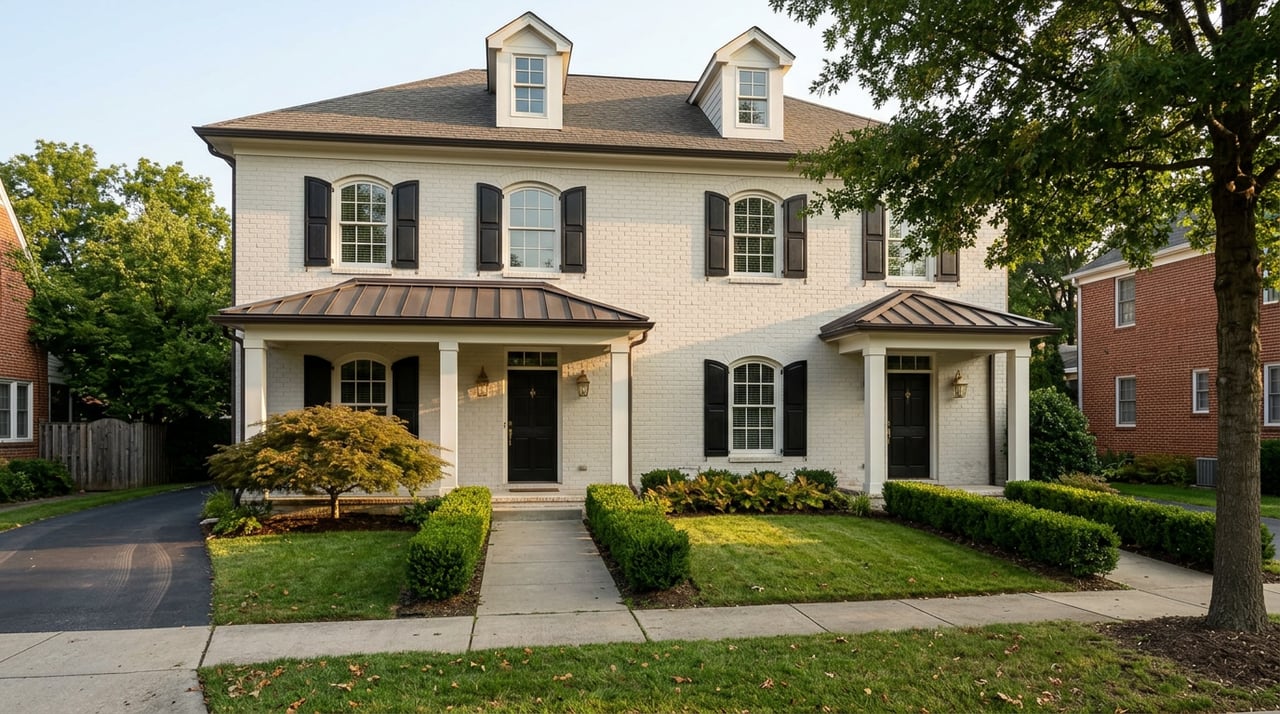
Compare that to a Virginia Square property that sold for $913,000 in 2022 and was assessed at $954,000 by 2024. Under the old rules, a home like that would likely have been torn down for one large single-family replacement. Instead it became the site of a six-plex, a building type that didn't pencil out as a single-family teardown but does pencil out split six ways. The land didn't get more valuable. The permitted use of the land did, and only because the ordinance happened to be legally alive at the moment that project moved through approval.
That's the real lesson underneath both of these sales. The price a lot commands has less to do with its lot lines and more to do with what a builder is legally allowed to put on it the day they close.
Why Two Blocks That Look Alike Can Price Differently Right Now
If you're comparing an EHO-eligible lot in Waverly Hills to a similar-looking lot two blocks over that sits outside an eligible district, you're not just comparing square footage and lot size. You're comparing two different bets on how a lawsuit resolves. One opposition group tracking the case put it more bluntly than most official statements do, describing the back-and-forth permit status as "self-inflicting zoning chaos" and warning that anyone buying an EHO-eligible property right now does so without guarantee that the permit will still be valid by the time they're ready to build.
That's not a reason to avoid these lots. It's a reason to price them with eyes open. A seller holding a teardown-candidate property in an R-6 district with an active or pending EHO permit is effectively selling optionality, the right to build six units instead of one, and that optionality is worth real money to the right buyer. But it's also worth less to a buyer who can't get financing or insurance comfortable with a permit that could be voided again if the Supreme Court sends the case back to trial.
What to Check Before You Write an Offer or Set a List Price
A few questions are worth asking before either side commits to a number on an EHO-eligible property:
- Is the specific permit currently listed as active on the county's EHO development dashboard, and when was that status last updated?
- Which zoning district does the lot sit in, R-5 or R-6, and how close is that district to its annual permit cap for the year?
- If the property already has an approved EHO permit, does the current owner have documentation showing it survived the 2024 void and the 2025 reinstatement without a gap?
- Has the seller or builder already pivoted the project back toward a single-family plan, and if so, why?
None of these questions require a law degree. They just require asking before the ink dries, not after.
A Short FAQ
Does this affect every home in Arlington, or just certain lots? Only lots zoned for single-family use in districts eligible for EHO are affected. Properties already zoned multifamily, along with condos and existing townhome communities, aren't part of this particular legal question.
What happens if the Virginia Supreme Court sides with the plaintiffs? The narrow question in front of the court is procedural. A ruling for the plaintiffs would send the case back to circuit court for a new trial that includes EHO permit holders as parties, not an immediate end to the ordinance itself. A ruling for the county would send the case back to the Court of Appeals to reconsider the timing issue that's currently on hold.
Is there a deadline on how long this uncertainty lasts? Not a firm one. Neighbors for Neighborhoods, the group funding the lawsuit, expects a new trial within three to six months of the Supreme Court's May 2026 order to take up the case, but nothing about this litigation has moved on a predictable schedule so far.
If you're weighing an Arlington lot against something in a neighboring jurisdiction, or trying to figure out what a specific property's zoning status actually means for its resale value, that's exactly the kind of local groundwork Ruth Garvey and the RGA Realty Group team walk clients through before an offer goes in, not after. Reach out for a free home valuation and a straight answer on where your property actually stands.